
Savannah area
Concrete contractors in Bryan County, GA
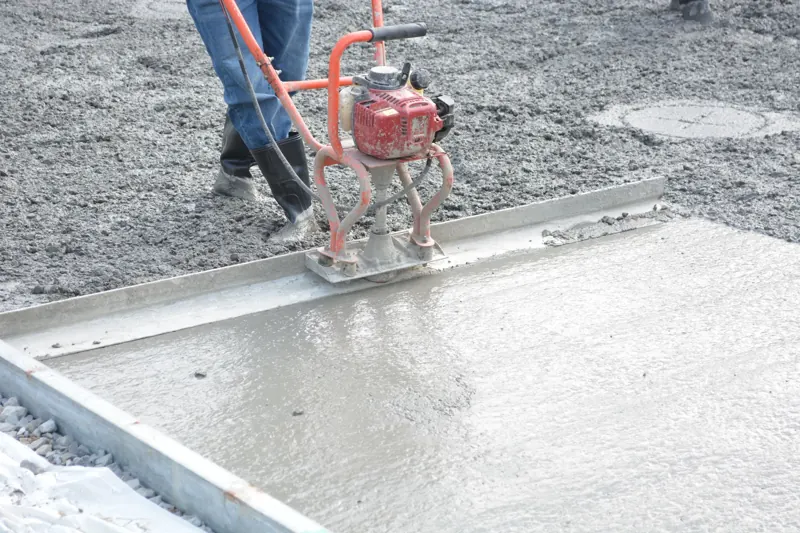
Driveways, patios, slabs, stamped concrete and repairs anywhere in Bryan County. Pick your city below or send the request straight away; we schedule a free on-site estimate.
Cities we serve in Bryan County
Not listed? We work across the whole county; the form takes every ZIP code in Bryan County.
What we pour across the county
Concrete conditions in Bryan County
Averages from the nearest NOAA climate normals station, Ft Stewart, GA (14.9 miles away, 92 ft), over 1991–2020.[1] Conditions can change over short distances, so treat these as a planning guide, not a forecast.
- Nights at 32°F or below
- 21
- Days at 90°F or above
- 94
- Precipitation a year
- 51 in
- Average temperature
- 68°F
Heat and drying
Heat is the main scheduling issue: about 94 days a year reach 90°F, 69 of them in June–August. NRMCA's hot-weather guidance is to avoid placing and finishing during the hottest part of the day, never to sprinkle water on the slab to ease finishing, and to use sunscreens, windbreaks, fogging or evaporation retarders when it is dry and windy, because fast evaporation causes plastic shrinkage cracks. We order a set-retarding admixture when the day calls for it and start early.[4]
Cold and freeze-thaw
Freezing nights are a regular part of winter in Bryan County, about 18 of them in December–February, but rare outside it. A pour between late fall and early spring may need the cold-weather precautions ACI describes for air temperatures expected below 40°F. For driveways, walks and patios that freeze while wet, NRMCA recommends air-entrained concrete to resist scaling. Our estimates say whether the mix is air-entrained.[2, 3]
With 51 inches of precipitation a year, we plan how fresh concrete gets covered if rain arrives during or soon after the pour, and slope the finished slab to shed water away from the house.
Homes in Bryan County
Bryan County has about 17,957 homes. The median home was built in 2005, and 19% were built before 1980. 78% are owner-occupied. With many newer homes, a lot of work here extends an existing driveway or adds a patio. We match the thickness and finish of the concrete already in place.[5]
Planning guides: pouring in summer heat · pouring in cold weather · curing times · driveway thickness
- NOAA National Centers for Environmental Information, U.S. Climate Normals 1991–2020 (annual and seasonal, by station) (archive c20230404; imported November 6, 2026), station USC00093538.
- American Concrete Institute, ACI 306R-16: Guide to Cold Weather Concreting (preview) (2016 edition; checked October 6, 2026).
- National Ready Mixed Concrete Association, CIP 2: Scaling Concrete Surfaces (checked October 30, 2026).
- National Ready Mixed Concrete Association, CIP 12: Hot Weather Concreting (checked October 30, 2026).
- U.S. Census Bureau, American Community Survey 2020–2024 5-year estimates (tables B25003, B25034, B25035) (imported October 30, 2026).
Permits and inspections in Bryan County
Driveway aprons that meet a public road, retaining walls above a set height and slabs that carry a structure usually need a permit, issued by the county or by the city the property sits in. We tell you at the estimate which permits your job needs and pull them as part of the work. Where an inspection is required, we schedule it and have the forms and steel ready for the inspector.